This document briefly describes the following:
- How the opening balance is calculated.
- Which transactions are included as expected payments for the various cash flow forecast types.
- How the expected payment deviation calculation is performed.
Opening balance
The opening balance is calculated based on the G/L transactions in IBS Enterprise. The document date is used to determine which transactions to include in the opening balance. The starting date includes all available transactions and the end date is the date when the collection is performed. This means that any future G/L postings, i.e., document dates later than the date when the collection is performed, are not included in the opening balance.
For currency accounts a summary is made for the currency dedicated to the account. For non-currency accounts the transaction currency will be the same as the system currency. In the event of multiple currencies used on one account, the transaction currency and transaction amount is set equal to the system currency and system amount.
Preloaded cash flow forecast types
The following types are preloaded at installation:
| Cash flow forecast type | Description | Information collected automatically from IBS Enterprise Y/N * |
|---|---|---|
| A/P | A/P documents | Y |
| A/R | A/R documents | Y |
| ARDIS | A/R invoices in transfer from DIS to FIN | Y |
| PURCHASE | Purchase orders | Y |
| SALES | Sales orders | Y |
| INTEREST | Interest | N |
| LOANS | Loans | N |
| PERSONNEL | Personnel | N |
| TAXES | Taxes | N |
| VAT | VAT | N |
* Expected payments for A/P, A/R, ARDIS, PURCHASE and SALES are automatically updated by the system. Interest, Loans, Personnel, Taxes and VAT must be updated manually by the user.
Cash flow forecast types
For the automatically updated cash flow forecast types the transactions meeting the following criteria are included as expected payments:
SALES
- Expected payment date is calculated as:
Dispatch date + number of credit days defined for the terms of payment + number of Expected payment deviation days for the business partner - Order status. Includes sales order lines with order status 10-59.
- Confirmed. Includes confirmed orders.
- Active. Includes active order lines.
- Hold status. Excludes held orders.
- Fees. Dispatch date for freight, postage, insurance, administration and invoice fees will be the same as the earliest dispatch date. These fees are always included on the first invoice sent to the customer.
- Estimated surcharges. These will not be included in the cash flow forecast.
- Credit sales orders. The expected payment date is calculated the same way as for debit orders.
- Periodic invoicing. For debtors with periodic invoicing the expected payment date will be calculated as:
Dispatch date + (invoice frequency/2) + number of credit days defined for the terms of payment + expected payment deviation days - Order settlement. Three types of order settlements are supported:
- Cash discount. Cash discount amounts are not deducted from the expected payment amount.
- SMS, supplier marketing support. Rebate claims are not included until the supplier is invoiced.
| Type | Description |
|---|---|
| 1 | Expected |
| 2 | Received |
| 3 | Posted |
Types 1 and 2 will be included in the cash flow forecast with its total order amount. Type 3 order settlements will be included with its remaining order amount. In other words, the payment amount already received and posted in A/R will be deducted from the total order amount. If the order has not been completely settled and the dispatch dates for the order lines vary it will be assumed that the order lines with the oldest dispatch date are settled.
Note: Orders settled by credit card are never considered as paid, i.e., the order is included with its original amount. The reason is that the money is only reserved (never received) until the order is invoiced.
ARDIS
This cash flow forecast type holds information about expected payments based on invoiced sales orders not yet updated in the Accounts Receivable.
- Expected payment date is calculated as:
Due date + number of Expected payment deviation days for the business partner - Credit notes. The expected payment date (= the date when the customer is expected to use the credit note) is calculated the same way as for invoices:
Due date + number of Expected payment deviation days for the business partner - Record type. Includes only invoices originating from IBS Distribution, i.e., invoices updated in this file from other pre-systems will be disregarded.
- Journals in error. Erroneous invoices kept in the routine Journals in error in IBS Financials are excluded.
- Cash discount. Cash discount amounts are not deducted from the expected payment amount.
A/R
- Expected payment date is calculated as:
Due date + number of Expected payment deviation days for the business partner - Credit notes. The expected payment date (= the date the customer is expected to use the credit note) is calculated the same way as for invoices:
Due date + number of Expected payment deviation days for the business partner - Open payments. The expected payment date (= the date the customer is expected to use the open payment) is calculated the same way as for invoices:
Due date + number of Expected payment deviation days for the business partner - Cash discount. Cash discount amounts are not deducted from the expected payment amount.
- Portfolio documents. Bill document (data type 6) will be included with an expected payment same as the due date. Other portfolio documents are not included in the cash flow forecast.
Note: Due date for a bill document with data type 6 is the same as the due date of the originating invoice(s).
PURCHASE
- Expected payment date is calculated as:
Dispatch date + number of credit days defined for the terms of payment + number of Expected payment deviation days - Order status. Include sales order lines with status 10 -39.
- Confirmed. Include non-confirmed orders. All non-confirmed orders are included since it is common that purchase orders are not confirmed at all.
- Active. Include active order lines.
- Hold status. Held orders with reason code 31 or 32 are excluded.
- Return to suppliers. The expected payment date is calculated the same way as for credit orders.
- Cash discount. Cash discount amounts are not deducted from the expected payment amount.
- MDC, Multi-Distribution Centre. No exception is made for a cash flow forecast within an MDC environment.
A/P
- Expected payment date is calculated as:
Due date + number of Expected payment deviation days for the business partner - Preliminary invoices. The expected payment date is calculated the same way as for invoices:
Due date + number of Expected payment deviation days for the business partner - Credit notes. The expected payment date (= the date when the credit note is expected to be used) is calculated the same way as for invoices:
Due date + number of Expected payment deviation days for the business partner - Open payments. The expected payment date (= the date the open payment is expected to be used) is calculated the same way as for invoices:
Due date + number of Expected payment deviation days for the business partner - Cash discount. Cash discount amounts are not deducted from the expected payment amount.
Calculated expected payment deviation days
The expected payment deviation days are calculated as follows:
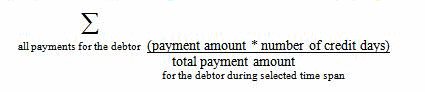
| all payments for the debtor (payment amount * number of credit days) / total payment amount – for the debtor during selected time span |
The following documents are not considered (used) in the calculation:
- Invoices with a payment stop code.
- Credit notes.
- Open payments, i.e., the part of the payment that has not yet been settled. This means that on account payments will not be included in the calculation.
Note: One expected payment deviation days figure per business partner and business partner type will be created. This means that if a business partner is defined as both debtor and supplier two calculations will be made; one for the debtor and one for the supplier.